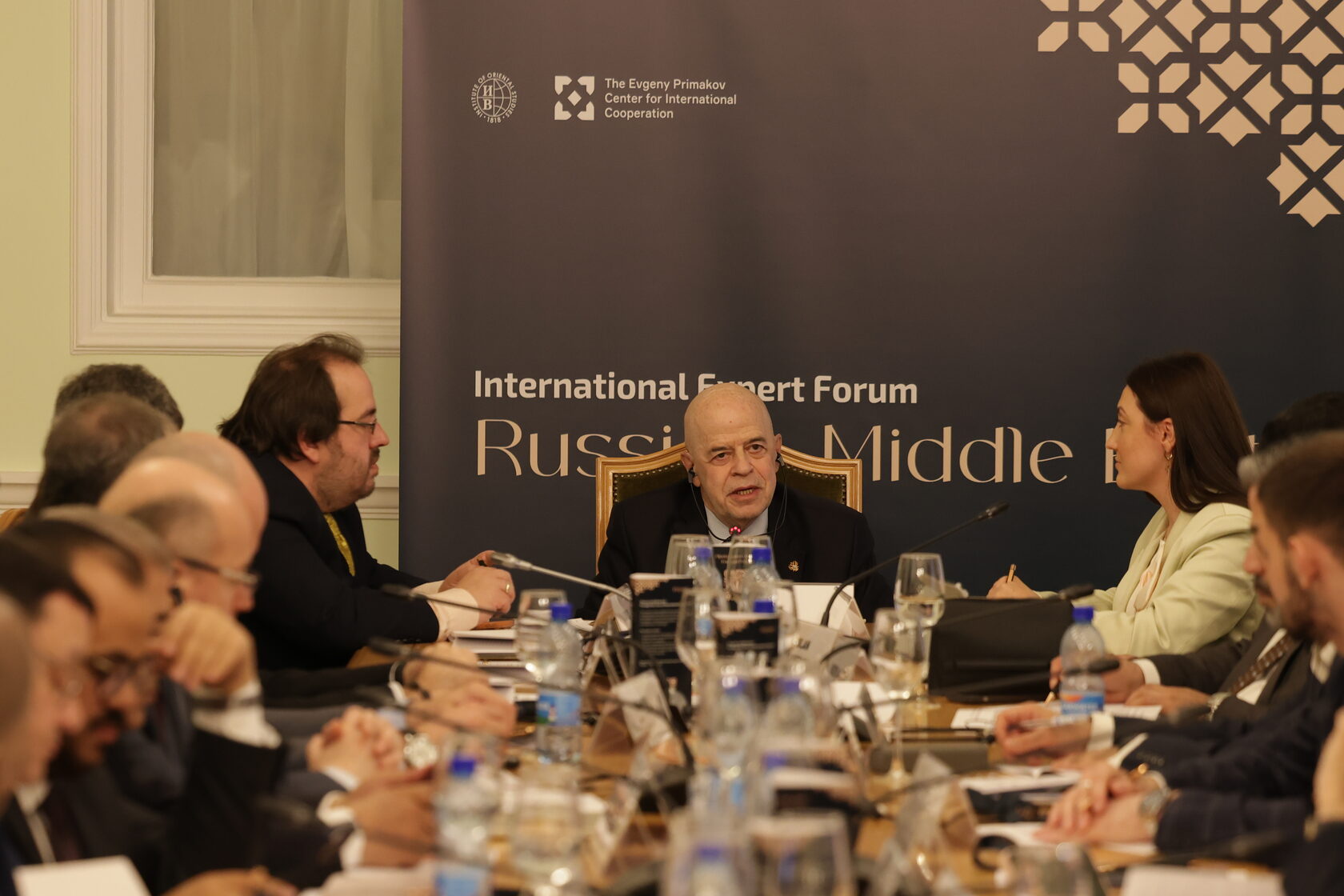
The 6th International Expert Forum “Russia — Middle East”, organized by the Primakov Center in partnership with the Institute of Oriental Studies of the Russian Academy of Sciences, has opened in Moscow. The event brought together leading representatives of the expert community, academic institutions, and analytical centers from 12 countries, including Algeria, the United Kingdom, Jordan, Iraq, Iran, Lebanon, Oman, the UAE, Pakistan, Russia, Syria, and Türkiye.
Opening the forum, Vasily Kuznetsov, Academic Director of the Forum and Deputy Director of the Institute of Oriental Studies, noted that the program focuses on the most pressing and significant developments shaping the future of the region:
“At this forum, we are discussing the key processes that will define the future of the Middle East. One of the central issues is the Palestinian-Israeli conflict. Despite the complexity of the current situation, it is clear that the Palestinian question will remain on both the regional and global agenda. Equally important are issues of security in the Gulf, relations among regional states, and the role of external actors. Particular attention should also be paid to political Islam: recent developments have shown that it has not disappeared from politics but continues to evolve and influence regional processes.”
Victoria Karslieva, Executive Director of the Primakov Center, emphasized the importance of direct expert dialogue amid the rapidly changing regional environment:
“Despite all the complexity and conflict in the Middle East, we firmly believe that it is impossible to understand the region, write about it, or formulate expert assessments without listening to the people who live and work there. This is precisely why we gather at this forum — to hear one another, discuss the most pressing issues, and seek common ground. It is especially important for us to bring together experienced experts and young researchers, creating a space for open and meaningful dialogue.”
Speaking at the opening session, Academician Vitaly Naumkin, Scientific Director of the Institute of Oriental Studies, stressed that building a sustainable regional security system is impossible without broad and inclusive dialogue. According to him, the very fact that experts from different countries are willing to discuss sensitive issues demonstrates a demand for developing common approaches to the region’s future.
One of the key events of the first day was the presentation of the report “Russia and West Asia Through the Eyes of International Experts.” The report was presented by its Executive Editor, Ruslan Mamedov, PhD in History, Scientific Director of the Primakov Center and Senior Research Fellow at the Center for Arab and Islamic Studies of the Institute of Oriental Studies.
“In preparation for the forum, we set ourselves the task of bringing together international perspectives on the processes unfolding in the Middle East. This led to the creation of the report Russia and West Asia Through the Eyes of International Experts. It brings together contributions from scholars representing different countries and academic traditions, ranging from fundamental academic analysis to applied policy forecasting. For us, this study continues our efforts to reflect on Russia’s role in the region and responds to the growing demand for expert support of Russia’s relations with the countries of West Asia.”
The study brings together assessments by Russian and international experts on Russia’s relations with regional states, the transformation of the international order, the role of external actors, and prospects for resolving key conflicts in the Middle East. It is the first report produced by the Primakov Center in broad cooperation with international experts, offering a diversity of perspectives on regional developments and their implications for global affairs.
A special highlight of the first day was a meeting between forum participants and Georgy Borisenko, Deputy Minister of Foreign Affairs of the Russian Federation. He noted that the forum has established itself as an authoritative platform for cooperation between the expert and diplomatic communities of Russia and the countries of the Middle East and North Africa. In his remarks, Borisenko focused on Russia’s relations with regional states, highlighting the growth of political contacts, expanding trade and economic cooperation, as well as humanitarian and educational exchanges.
The first day’s program also featured two expert sessions devoted to the most pressing regional challenges. Participants discussed prospects for creating an inclusive security architecture in the Middle East and examined possible scenarios for the development of the Palestinian-Israeli conflict, with particular attention to new approaches to conflict resolution and the restoration of political dialogue.
The forum will continue tomorrow with discussions on the consequences of recent conflicts in the Middle East, the transformation of the regional order, and the future of political Islam in a changing international environment.
Opening the forum, Vasily Kuznetsov, Academic Director of the Forum and Deputy Director of the Institute of Oriental Studies, noted that the program focuses on the most pressing and significant developments shaping the future of the region:
“At this forum, we are discussing the key processes that will define the future of the Middle East. One of the central issues is the Palestinian-Israeli conflict. Despite the complexity of the current situation, it is clear that the Palestinian question will remain on both the regional and global agenda. Equally important are issues of security in the Gulf, relations among regional states, and the role of external actors. Particular attention should also be paid to political Islam: recent developments have shown that it has not disappeared from politics but continues to evolve and influence regional processes.”
Victoria Karslieva, Executive Director of the Primakov Center, emphasized the importance of direct expert dialogue amid the rapidly changing regional environment:
“Despite all the complexity and conflict in the Middle East, we firmly believe that it is impossible to understand the region, write about it, or formulate expert assessments without listening to the people who live and work there. This is precisely why we gather at this forum — to hear one another, discuss the most pressing issues, and seek common ground. It is especially important for us to bring together experienced experts and young researchers, creating a space for open and meaningful dialogue.”
Speaking at the opening session, Academician Vitaly Naumkin, Scientific Director of the Institute of Oriental Studies, stressed that building a sustainable regional security system is impossible without broad and inclusive dialogue. According to him, the very fact that experts from different countries are willing to discuss sensitive issues demonstrates a demand for developing common approaches to the region’s future.
One of the key events of the first day was the presentation of the report “Russia and West Asia Through the Eyes of International Experts.” The report was presented by its Executive Editor, Ruslan Mamedov, PhD in History, Scientific Director of the Primakov Center and Senior Research Fellow at the Center for Arab and Islamic Studies of the Institute of Oriental Studies.
“In preparation for the forum, we set ourselves the task of bringing together international perspectives on the processes unfolding in the Middle East. This led to the creation of the report Russia and West Asia Through the Eyes of International Experts. It brings together contributions from scholars representing different countries and academic traditions, ranging from fundamental academic analysis to applied policy forecasting. For us, this study continues our efforts to reflect on Russia’s role in the region and responds to the growing demand for expert support of Russia’s relations with the countries of West Asia.”
The study brings together assessments by Russian and international experts on Russia’s relations with regional states, the transformation of the international order, the role of external actors, and prospects for resolving key conflicts in the Middle East. It is the first report produced by the Primakov Center in broad cooperation with international experts, offering a diversity of perspectives on regional developments and their implications for global affairs.
A special highlight of the first day was a meeting between forum participants and Georgy Borisenko, Deputy Minister of Foreign Affairs of the Russian Federation. He noted that the forum has established itself as an authoritative platform for cooperation between the expert and diplomatic communities of Russia and the countries of the Middle East and North Africa. In his remarks, Borisenko focused on Russia’s relations with regional states, highlighting the growth of political contacts, expanding trade and economic cooperation, as well as humanitarian and educational exchanges.
The first day’s program also featured two expert sessions devoted to the most pressing regional challenges. Participants discussed prospects for creating an inclusive security architecture in the Middle East and examined possible scenarios for the development of the Palestinian-Israeli conflict, with particular attention to new approaches to conflict resolution and the restoration of political dialogue.
The forum will continue tomorrow with discussions on the consequences of recent conflicts in the Middle East, the transformation of the regional order, and the future of political Islam in a changing international environment.